Face length
Measure from the top of the visible hairline or upper forehead to the lowest point of the chin.
Manual face shape guide
Use a mirror or straight-on photo to compare face length, forehead, cheekbones, jawline, and chin shape, then confirm your closest match with the detector.
Face-shape labels are practical styling references, not medical or biometric results. Mixed traits are normal.
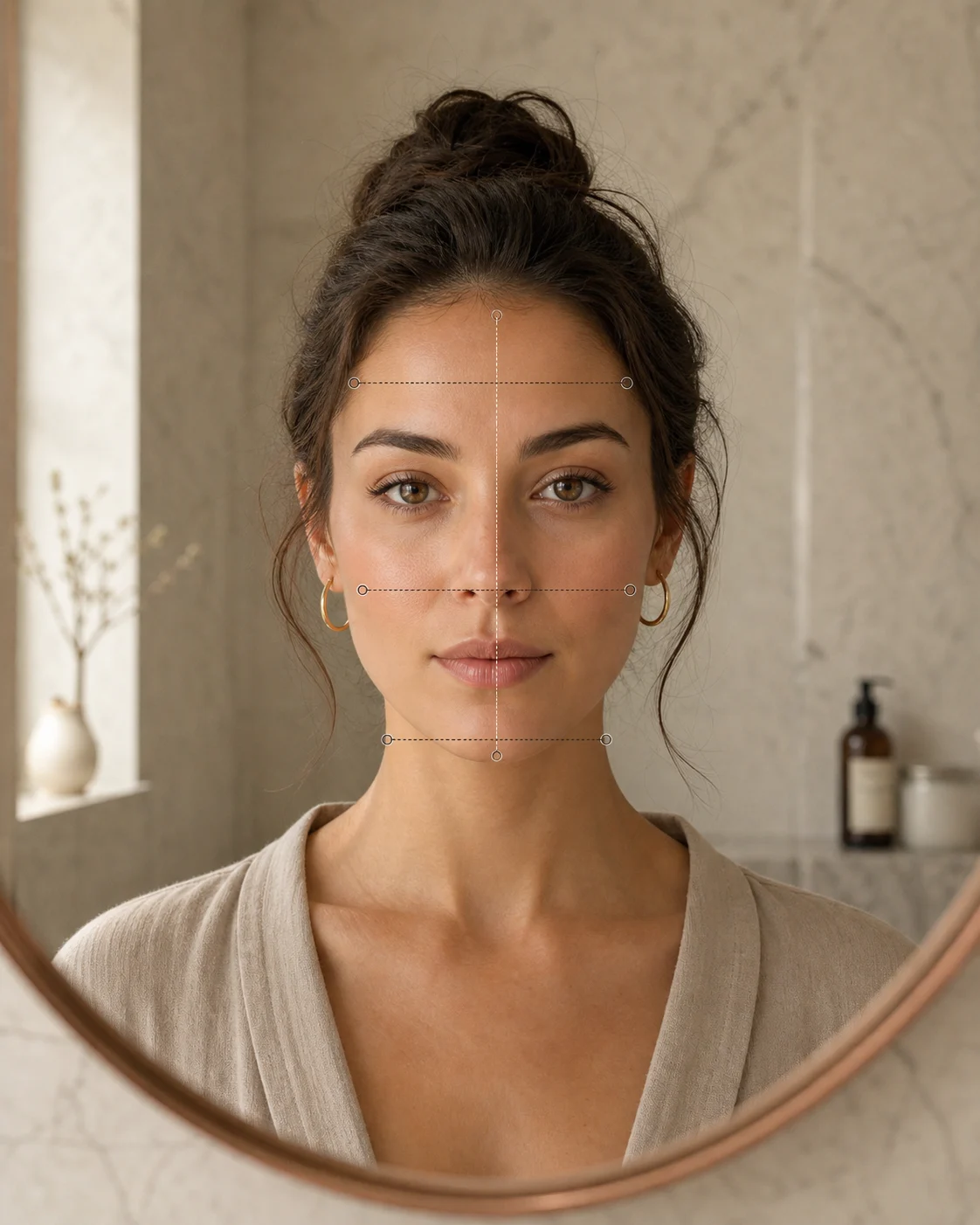
Manual face-shape checkpoints
Method
Manual proportion check
Input
Mirror or photo
Output
Closest face-shape match
Measurement map
You do not need perfect numbers. Consistent checkpoints are enough to see which area is widest and whether length or width dominates.
Measure from the top of the visible hairline or upper forehead to the lowest point of the chin.
Compare the width across the upper face, near the widest part of the forehead.
Check the widest point across both cheekbones. This is often the baseline for comparing other widths.
Look at the lower face from jaw corner to jaw corner, then compare it with the forehead and cheekbones.
Notice whether the chin reads rounded, square, narrow, or pointed, because it can separate close matches.
Step-by-step
Work from visible structure first, then choose the closest category instead of forcing an exact label too early.
The photo detector uses local landmark analysis and proportion scoring, so it is useful when mirror checks feel close between two shapes.
Step 1
Use a front-facing mirror view or a clear portrait. Keep the head level, pull hair away from the outline, and avoid strong shadows.
Step 2
Write down face length, forehead width, cheekbone width, jawline width, and chin shape in the same unit or visual scale.
Step 3
If cheekbones are widest, diamond may be close. If forehead leads and the chin narrows, heart is more likely. If the jaw leads, compare triangle or square.
Step 4
A face that is clearly longer than wide may point toward oval or oblong. A compact face with softer angles may point toward round.
Step 5
Most faces sit between categories. Compare your top two shapes, then use the detector when you want a photo-based proportion check.
Measurement worksheet
Use the same unit for every distance and keep the tape or on-screen ruler level. Record each value once, then repeat the full set. If repeated readings differ by more than about three percent, fix the photo or measuring position before classifying the face.
| Checkpoint | What to record | How to use it |
|---|---|---|
| Face length | Hairline or upper-forehead reference to the lowest point of the chin: ____ | Divide by cheekbone width. A larger ratio makes oval, oblong, rectangle-like, or diamond patterns more plausible, but it is not a category by itself. |
| Forehead width | Widest visible upper-face line, with hair moved away: ____ | Compare with cheekbones and jaw. A clear upper-face lead supports heart; a narrow forehead can support diamond or triangle, depending on the lower face. |
| Cheekbone width | Outer cheekbone point to outer cheekbone point: ____ | Use this as the main width baseline. A clear cheekbone peak supports diamond; a value close to face length can support a compact round pattern. |
| Jaw width | Jaw corner to jaw corner, without following beard volume: ____ | A broad jaw can support square or triangle. A jaw close to the other widths plus extra length can support rectangle-like structure. |
| Chin and jaw finish | Mark one: rounded / tapered / pointed / broad and flat | Use this qualitative cue to break close ties. It should refine the width pattern, not override several measurements that point elsewhere. |
Length 19.2 cm · forehead 14.2 · cheekbones 14.6 · jaw 13.8 · rounded-tapered chin
Face length is about 32% greater than cheekbone width, while the three widths remain fairly balanced and the lower face tapers gently. Oval is the useful first match. Oblong stays secondary because the sides are not especially straight and length does not overwhelm the outline. These numbers illustrate a reasoning process, not a universal cutoff.
Length 18.4 cm · forehead 13.1 · cheekbones 14.9 · jaw 12.8 · narrow chin
The cheekbones are about 14% wider than the forehead and 16% wider than the jaw, so the midface is visibly dominant. That supports diamond. Heart would move closer only if the upper face matched or exceeded the cheekbone line. Retake the measurements before deciding when any two widths differ by only a few millimeters.
Result guide
Use the chart as a practical reference for styling decisions. The closest match matters more than a perfect label.
Balanced width with extra length
An oval face is gently longer than it is wide, with smooth transitions through the forehead, cheekbones, and jaw.
Similar length and width
A round face has soft curves, full cheeks, and little angular change between the cheekbones and jaw.
Even widths with a strong jaw
A square face shows comparable forehead, cheekbone, and jaw widths with a defined lower edge.
Broad upper face, narrow chin
A heart-shaped face is widest around the forehead and gradually narrows through the jaw to the chin.
Noticeably longer than wide
An oblong face has extended vertical proportions and fairly consistent width from forehead to jaw.
Cheekbones are the widest point
A diamond face narrows at both the forehead and jaw while the cheekbones create its strongest width.
Jaw wider than forehead
A triangle face builds width toward the lower face, with a narrower forehead and a broader jawline.
Accuracy checks
Small setup issues can make a manual read drift toward the wrong category. Fix these before comparing shapes.
A turned or tilted head changes visible widths. Use a front-facing view with the eye line close to level.
Hair volume can make the forehead or jaw look wider than it is. Pull hair away from the face when checking the outline.
Many faces share traits across two shapes. Treat the second-closest match as useful context, not as a failed result.
Manual measurements vary by photo and posture. The pattern between measurements is more important than the absolute number.
Resolve close results
A mixed result is useful information. Preserve the strongest relationship, record the secondary pattern, and improve the input before trying to force every feature into one label.
When two widths are within roughly three percent, the difference may come from landmark placement rather than anatomy. Mark them as tied and let face length, jaw angle, and chin taper decide the next comparison.
If the detector and worksheet disagree, use a new eye-level photo with neutral expression, even light, no filter, and the full outline visible. Compare the explanation cues as well as the label; the detector chooses the nearest of seven supported categories.
The detector does not output a separate rectangle category. If it returns oblong, square, or oval, use that as the nearest supported result, then check manually for extra length, straighter sides, similar forehead and jaw widths, and a structured jaw.
Manual face shape FAQ
Short answers for manual measurement, photo checks, mixed traits, and when to use the detector.
Measure or compare face length, forehead width, cheekbone width, jawline width, and chin shape. Then match the dominant pattern to the closest face-shape category.
Use a straight-on portrait with the full face visible. Avoid tilt, heavy shadows, filters, and hair covering the jawline or forehead.
Yes, you can make a visual comparison, but measurements help when two shapes feel close. At minimum, compare the widest area and the face length.
That is common. Use the closest shape as the main styling reference and keep the second shape in mind for details like glasses, hair, or contour choices.
Use the detector when you want a photo-based check with visible proportion cues. It is a faster second opinion after a manual read.
Upload a clear selfie, review the landmark overlay, and compare the detected face shape with your manual measurement notes.