What a face shape describes
A face shape is a shorthand for the relationship between five visible features: face length, forehead width, cheekbone width, jaw width, and chin contour. It is not a biometric identity, a health assessment, or a rule about attractiveness. The label is useful when it turns several measurements into a simple reference for comparing proportions, discussing a haircut, or understanding why two faces with similar width can still have different outlines.
Most guides use seven core labels: oval, round, square, heart, oblong, diamond, and triangle. Some also use rectangle for a long face with straighter sides and a more angular jaw. Real faces rarely match a diagram perfectly. A useful result is therefore the closest overall pattern plus a second pattern that explains any mixed traits.
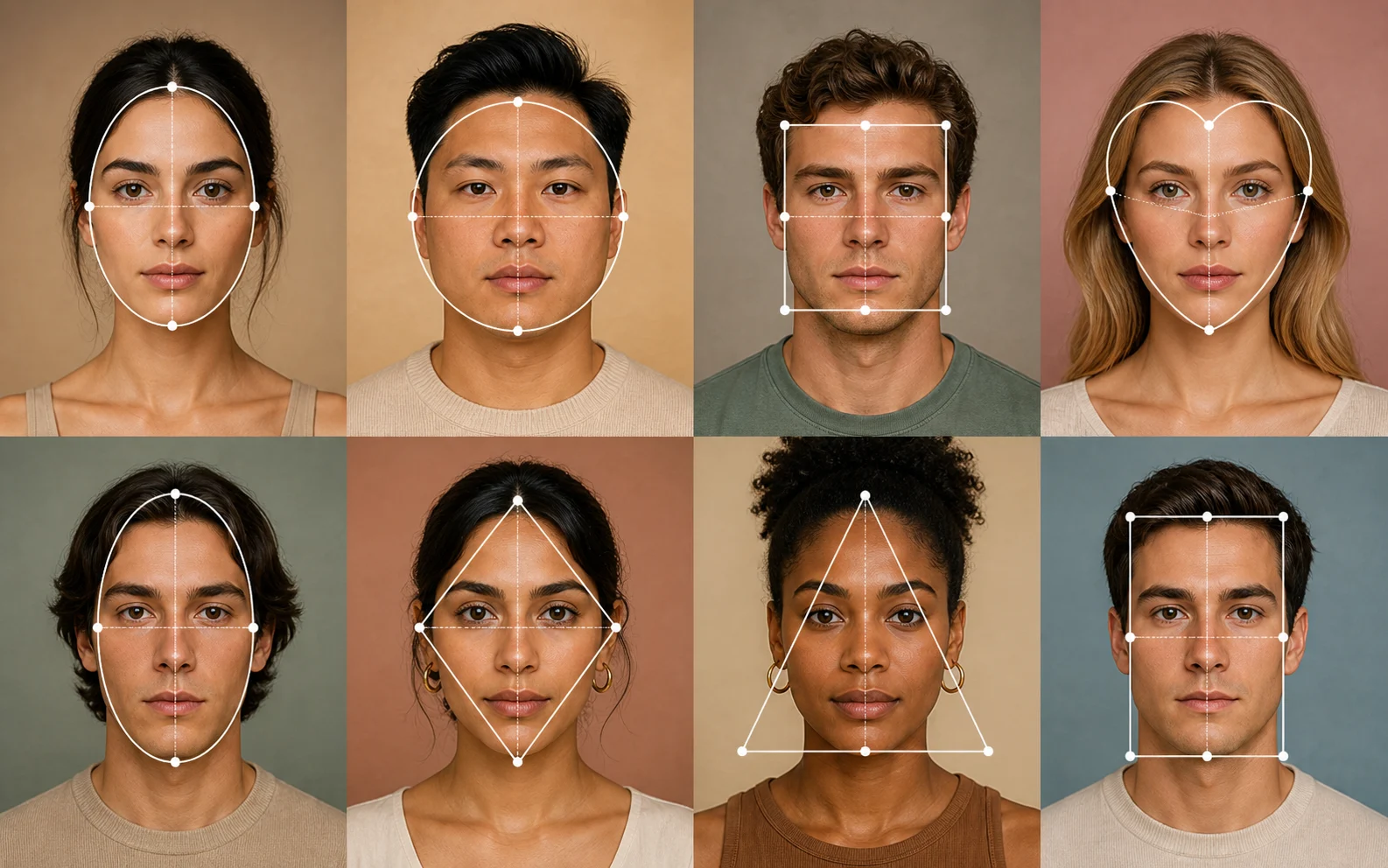
Use outline diagrams as comparison aids, not exact templates. Width relationships are more reliable than matching a silhouette by eye.
Face-shape comparison table
The table summarizes the usual pattern for each label. “Similar” means two widths are close enough that neither clearly dominates. Small differences are normal, and camera angle can make them look larger than they are.
Shape | Face length | Forehead | Cheekbones | Jaw | Chin |
|---|---|---|---|---|---|
| Oval | Longer than wide | Balanced | Often slightly widest | Gently narrower | Rounded |
| Round | Close to width | Soft, balanced | Broad | Curved | Rounded |
| Square | Close to width | Broad | Similar to forehead | Broad, angular | Flat or squared |
| Heart | Moderate | Broad | Broad to balanced | Narrower | Tapered or pointed |
| Oblong | Clearly dominant | Often similar | Often similar | Often similar | Rounded or softly squared |
Rectangle | Clearly dominant | Broad, even | Similar | Broad, angular | Squared |
Diamond | Moderate to long | Narrower | Clearly widest | Narrower | Tapered |
| Triangle | Varies | Narrower | Moderate | Clearly widest | Broad or softly squared |
No single column decides every case. Face length separates many oval or oblong faces from round or square faces, while the relationship among forehead, cheekbones, and jaw separates heart, diamond, and triangle patterns. Chin shape is a supporting cue: a pointed chin does not automatically make a face heart-shaped if the cheekbones, rather than the upper face, are clearly widest.
Core principles for identifying your face shape
When categorizing facial structure, stylists and proportion guides focus on five anatomical checkpoints rather than arbitrary impressions:
- Length-to-width proportion: Face length (hairline to chin) versus cheekbone width separates elongated categories (oval, oblong, rectangle) from compact ones (round, square).
- Three horizontal widths: Comparing forehead width, cheekbone span, and jaw width establishes whether the outline is upper-face-led (heart), cheekbone-led (diamond), lower-face-led (triangle), or relatively uniform (oval, square, oblong).
- Lateral contours: Observing whether lateral cheek borders curve smoothly (round, oval) or drop straighter (oblong, square, rectangle).
- Jaw structure and chin angles: Angular corners define square and rectangle shapes; tapered, pointed tips characterize heart and diamond shapes; soft, curved transitions define round and oval outlines.
- Primary vs. secondary traits: Human faces rarely conform to a single mathematical category. Recognizing a primary shape alongside secondary traits (such as "oblong with a structured square jaw") provides a far more actionable foundation for styling.
For the complete step-by-step measurement method, manual calculation chart, and worked examples, follow our dedicated guide on How to Determine Face Shape. If you prefer an instant photo-based analysis, upload a portrait to the AI Face Detector.
What each type means in practice
An oval face is longer than wide with gentle transitions and a jaw that is a little narrower than the upper face. A round face has a more compact length-to-width relationship and curved contours. The deciding distinction is proportion, not whether the cheeks look full in one photo; see the focused oval versus round comparison.
A square face combines relatively even widths with a broad, angular jaw. A triangle face shifts more width toward the jaw than the forehead. Both may show a strong lower face, but only the triangle pattern has a clear top-to-bottom increase in width.
A heart-shaped face is broader through the forehead or upper face and tapers toward the lower face. A diamond face is led by the cheekbones, with both forehead and jaw narrower. Their chins may look similarly tapered, so locating the widest region is more useful than focusing on the point of the chin.
An oblong face is defined first by length, usually with widths that remain fairly balanced. A rectangle label describes a similarly long outline with straighter sides and a more angular jaw; read the rectangle face guide when angularity is central. Oval is also longer than wide, but it normally shows more taper and softer transitions. The oblong versus oval guide walks through that boundary with measurements.
Mixed traits and close measurements
Measurements are not laboratory boundaries. A few millimeters can come from head tilt, hairline visibility, where the jaw point was placed, or the lens used. If the two widest regions differ by less than roughly five percent, describe them as similar rather than declaring a winner. Recheck the photograph and use the side contour as the tie-breaker.
Weight changes, aging, facial hair, hairstyle, makeup, and expression can change the visible outline without changing the underlying bone proportions in the same way. A beard can visually widen or lengthen the jaw. Bangs can hide the forehead. Contour can shift where the cheek appears strongest. When those factors are present, record what is obscured and lower your confidence instead of inventing a precise answer.
Mixed results are normal. “Oval with heart traits” can mean that length and soft taper support oval while a broader forehead supports heart. “Oblong with square traits” can mean length is decisive but the jaw is angular. The primary label should reflect the overall proportion pattern; the secondary label should explain the strongest exception.
The detector's seven labels and the rectangle label
The current detector returns one of seven primary categories: oval, round, square, heart, oblong, diamond, or triangle. Rectangle is included in this content guide as a useful descriptive and styling taxonomy, but it is not a separate detector output.
If you identify rectangle-like traits, interpret the detector result by checking length and jaw structure. A long, evenly proportioned face may return oblong; a more compact face with a broad angular jaw may return square. That does not mean the visual observation is invalid. It means the automated classifier and the broader editorial vocabulary use different label sets. The tool provides a best-fit category and proportion cues, not a final authority over how every guide names the outline.
Frequently asked questions
Can a person have two face shapes?
Yes. Categories summarize continuous proportions, so a primary match and a secondary influence are often more honest than one absolute label. Use the primary result for the overall outline and the secondary result to describe the feature that does not fit it perfectly.
Should I measure bone or visible skin edges?
Measure the visible facial outline consistently. For cheekbones and jaw, use the outermost visible points rather than trying to estimate bone under the skin. For the forehead, use the visible hairline and note when hair loss, bangs, or styling makes that boundary uncertain.
Does a wide jaw always mean a square face?
No. A square face usually has a broad jaw plus similar forehead and cheekbone widths, with face length relatively close to width. If the jaw is clearly wider than the forehead, triangle may be the better description. If the face is much longer, rectangle-like or oblong traits may matter more.
Is a long face automatically oblong?
No. Oval, diamond, heart, and rectangle patterns can also be longer than wide. Oblong becomes the strongest match when length clearly dominates while forehead, cheekbone, and jaw widths remain relatively even and the outline does not taper strongly.
Why do a mirror, selfie, and measured photo give different answers?
Mirrors reverse the image, close phone cameras exaggerate the center of the face, and head angle changes the visible outline. Use a level, front-facing photo taken from a little distance, then crop it without stretching. Repeat the measurement before changing the category.
Can face shape change over time?
The visible outline can change with age, body composition, dental work, hairstyle, or facial hair. The category may therefore appear different even when the underlying structure changes less. Reassess the current image if the goal is a current styling decision.
Is face-shape analysis medical or biometric analysis?
No. It is a broad visual proportion exercise for personal reference. It should not be used to identify a person, infer health or ancestry, diagnose a condition, or judge attractiveness.