The short answer
Both oblong and oval faces are longer than they are wide. The main difference is how the horizontal widths and side contours behave. An oval face normally has gentle taper: the cheekbones may be slightly widest, the jaw becomes a little narrower, and the outline curves smoothly toward a rounded chin. An oblong face is usually longer in relation to its width, with the forehead, cheekbones, and jaw remaining closer to one another. Its sides can look more parallel and its taper less pronounced.
Do not decide from face length alone. A long-looking portrait can be caused by a close camera, a high hairline, hair volume, or a narrow crop. Use a level reference photo, compare the same five dimensions, and keep a secondary match when the measurements fall between the two patterns.
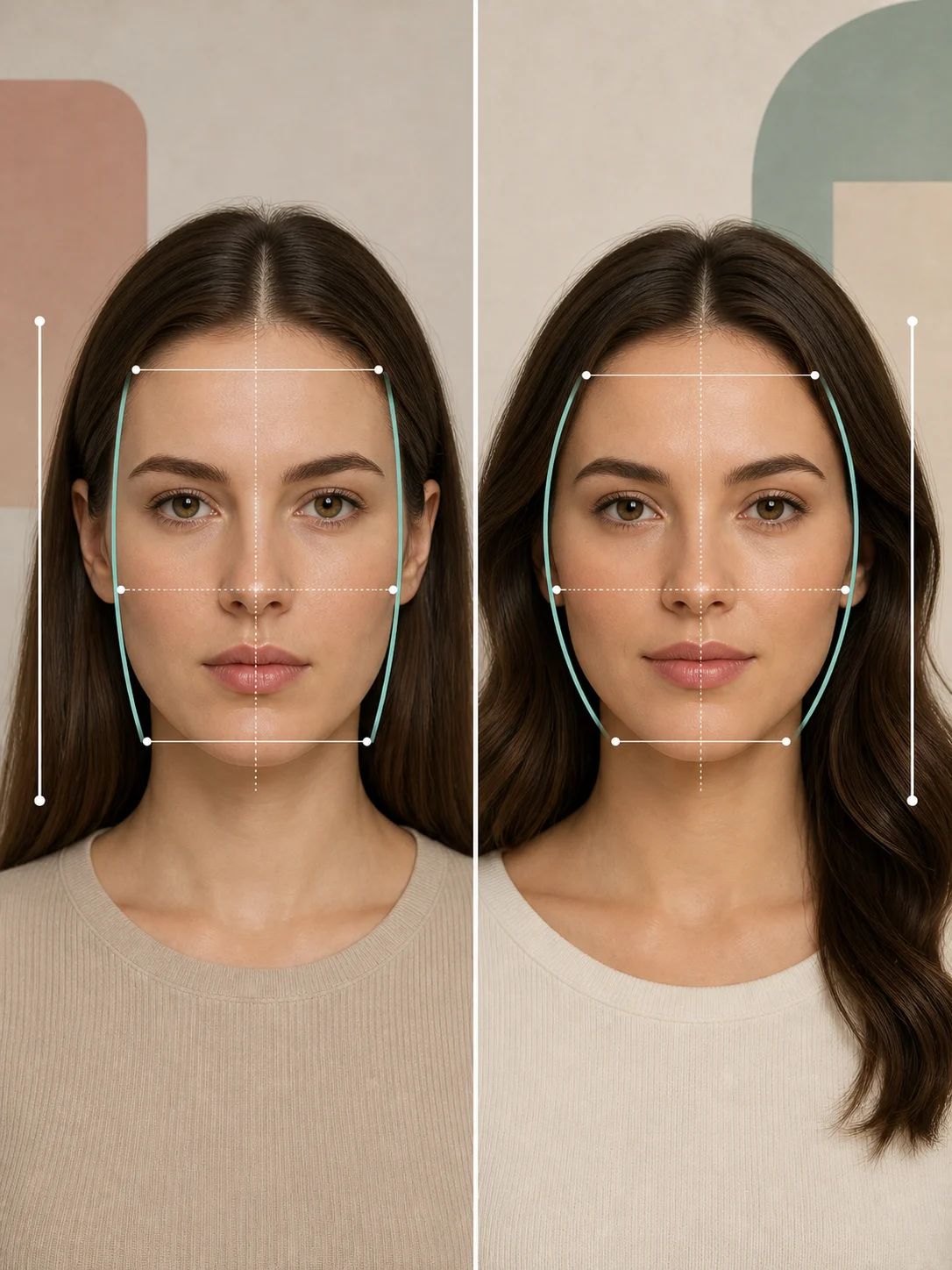
Compare ratios from one neutral photo. Measurements from different camera distances are not directly comparable.
Oblong and oval comparison table
Dimension | Oblong pattern | Oval pattern | What to verify |
|---|---|---|---|
Face length | Clearly dominant | Longer than wide, but less elongated | Length divided by cheekbone width |
Forehead | Often close to cheek and jaw widths | Balanced, often below cheekbone width | Visible width near the temples |
Cheekbones | Not strongly dominant | Often the widest point | Whether the sides bow outward |
| Jaw | Similar width, sometimes softly squared | Gently narrower and curved | Width and corner definition |
| Chin | Rounded or softly squared | Rounded with gradual taper | Transition from jaw, not the tip alone |
These are tendencies, not numerical laws. A person can have oblong length with an oval jaw, or oval proportions with straighter sides. The strongest evidence comes from the overall pattern, not from making one measurement fit a label.
How to measure the difference
Prepare one usable image
Take a front-facing photo at eye level from enough distance that the nose and center of the face are not exaggerated. Keep a neutral expression and place the whole forehead, both cheek edges, and both jaw corners in view. Move hair off the outline. If the hairline is unclear, mark the uncertainty rather than estimating a hidden point.
Record four measurements
- Face length: center of the visible hairline to the lowest point of the chin.
- Forehead width: the widest visible span across the upper forehead, usually near the temples.
- Cheekbone width: the widest span across the upper cheeks.
- Jaw width: from one jaw corner to the other. If measuring each side from chin to corner, combine both sides consistently.
The chin is better assessed as a contour than a fifth ruler measurement. Note whether the jaw flows into it through a soft curve, a gradual taper, or a noticeable corner.
Normalize the numbers
Absolute centimeters do not classify a face; ratios do. Divide face length by cheekbone width. Then compare forehead and jaw widths with the cheekbone measurement. A difference under about five percent is often better recorded as “similar,” especially when the photo is not a calibrated image. Do not treat a one- or two-millimeter change as a decisive category boundary.
A five-step decision process
Step 1: confirm that the face is longer than wide
If length and cheekbone width are very close, check oval versus round instead. If length clearly wins, both oblong and oval remain possible.
Step 2: look for cheekbone leadership
An oval outline often reaches its widest point around the cheekbones, even if the advantage is modest. An oblong outline more often keeps forehead, cheekbones, and jaw within a narrow range.
Step 3: trace the sides downward
Oval sides usually curve gently outward near the cheeks and then inward toward the jaw. Oblong sides tend to travel more vertically, so the face keeps more of its width from temple to lower cheek.
Step 4: inspect the jaw transition
A softly narrowed, rounded lower face supports oval. A jaw that stays close to the upper widths supports oblong. If the jaw is both broad and sharply angular, also compare the rectangle face guide; rectangle is an editorial label adjacent to oblong, not a separate output from the current detector.
Step 5: state confidence, not false certainty
Choose the label supported by most dimensions. If the ratios support oblong but the contour is distinctly oval, describe the result as “primarily oblong with oval softness.” Retake the photo before changing the result when the only difference comes from a questionable hairline or camera angle.
Worked example 1: length decides the result
Suppose a reference photo produces these proportional measurements: face length 19.2 units, cheekbones 13.1, forehead 12.8, and jaw 12.6. The length-to-cheekbone ratio is about 1.47. The three horizontal widths are within roughly four percent of each other, and the sides look fairly straight before a softly rounded chin.
This pattern is more consistent with oblong. Length is clearly dominant, while the cheekbones do not create the gentle middle-width emphasis expected in a typical oval outline. The rounded chin can be noted as an oval-like secondary trait, but it does not outweigh the near-parallel widths.
Worked example 2: taper decides the result
Now consider face length 18.0 units, cheekbones 13.4, forehead 12.7, and jaw 11.9. The length-to-cheekbone ratio is about 1.34. The cheekbones are about six percent wider than the forehead and thirteen percent wider than the jaw. The sides curve smoothly inward below the cheek line.
This result is more consistent with oval. The face remains longer than wide, but the cheekbone-led middle and clear lower-face taper matter more than length alone. Calling it oblong because the portrait “looks long” would ignore the width pattern.
These examples use relative units because screen pixels work when every line comes from the same undistorted photo. They are demonstrations, not universal diagnostic cutoffs.
Photo conditions that cause false differences
- A close wide-angle selfie: enlarges central features and can make the sides look narrower, exaggerating length.
- A camera below eye level: gives the chin and lower face more visual weight.
- A camera above eye level: can narrow the jaw and make an oblong face appear more oval.
- Hair covering the temples: hides forehead width and creates artificial taper.
- A high-volume hairstyle: adds apparent vertical length even though it is outside the measured face.
- A smile or clenched jaw: changes cheek width and jaw definition.
- A cropped forehead or chin: makes a length ratio unusable, even when the remaining image looks clear.
If two photos disagree, do not average incompatible measurements. Choose the more neutral photo, or retake both at the same distance and height.
When the result remains mixed
Use three checks. First, decide whether length is strongly or only moderately dominant. Second, ask whether the cheekbones form a real widest point. Third, decide whether the lower face tapers or keeps its width. If two checks favor one label and the third favors the other, keep both in the description.
Styling decisions do not require a perfect taxonomic answer. Someone with an oblong-oval mix can test suggestions from both the oblong guide and the oval guide, then keep the advice that addresses the feature they actually want to balance.
What the AI Face Detector can and cannot confirm
The AI Face Detector analyzes landmarks from a suitable photo and returns a best-fit category with a secondary match and proportion cues. It can help make the comparison repeatable, especially when visual guessing keeps changing.
It cannot see a hidden hairline or jaw, correct severe lens distortion, or turn these labels into medical facts. It also does not return rectangle as a separate category. Review the reported proportions alongside the photo rather than treating the category name as infallible.
Frequently asked questions
Is an oblong face simply a longer oval face?
Not exactly. Both are longer than wide, but oval usually shows more curvature and taper, often with cheekbones slightly wider than the forehead and jaw. Oblong more often keeps the three horizontal widths similar and has straighter sides.
Which ratio proves that a face is oblong?
No single ratio proves it. Length-to-width is useful only when combined with forehead, cheekbone, and jaw relationships. Camera distortion and measurement placement also make rigid internet cutoffs unreliable.
Can an oblong face have a rounded chin?
Yes. Chin contour is supporting evidence. A rounded chin does not override strongly dominant length and nearly even horizontal widths. Record it as a softer trait within the overall oblong pattern.
Can an oval face have a high forehead?
Yes. A high hairline can add visible length without changing the horizontal taper that supports oval. Measure from the visible hairline consistently and note uncertainty if the boundary is obscured.
Should I use a mirror or a photograph?
Use a level photograph for measurement because it preserves a fixed reference. A mirror is useful for a general outline check, but viewing distance, head movement, and reversed orientation make repeated measurements less consistent.
What should I do if manual measurements and the detector disagree?
Check the photo first. Confirm the full outline is visible, retake it at eye level, and repeat the measurements. Then compare the detector's proportion cues rather than only its label. If the evidence remains split, keep a primary and secondary category instead of forcing agreement.