The short answer
Oval and round faces can both have soft contours, broad cheek areas, and rounded chins. The most reliable difference is proportion. An oval face is noticeably longer than it is wide and usually tapers gently below the cheekbones. A round face has a face length closer to its cheekbone width, with fuller side curves and less narrowing through the jaw.
Cheek fullness by itself is not a face-shape measurement. Expression, lighting, body composition, and a close phone camera can all make the cheeks look rounder. Use a neutral photo and compare length, three horizontal widths, and the lower-face transition before choosing a label.
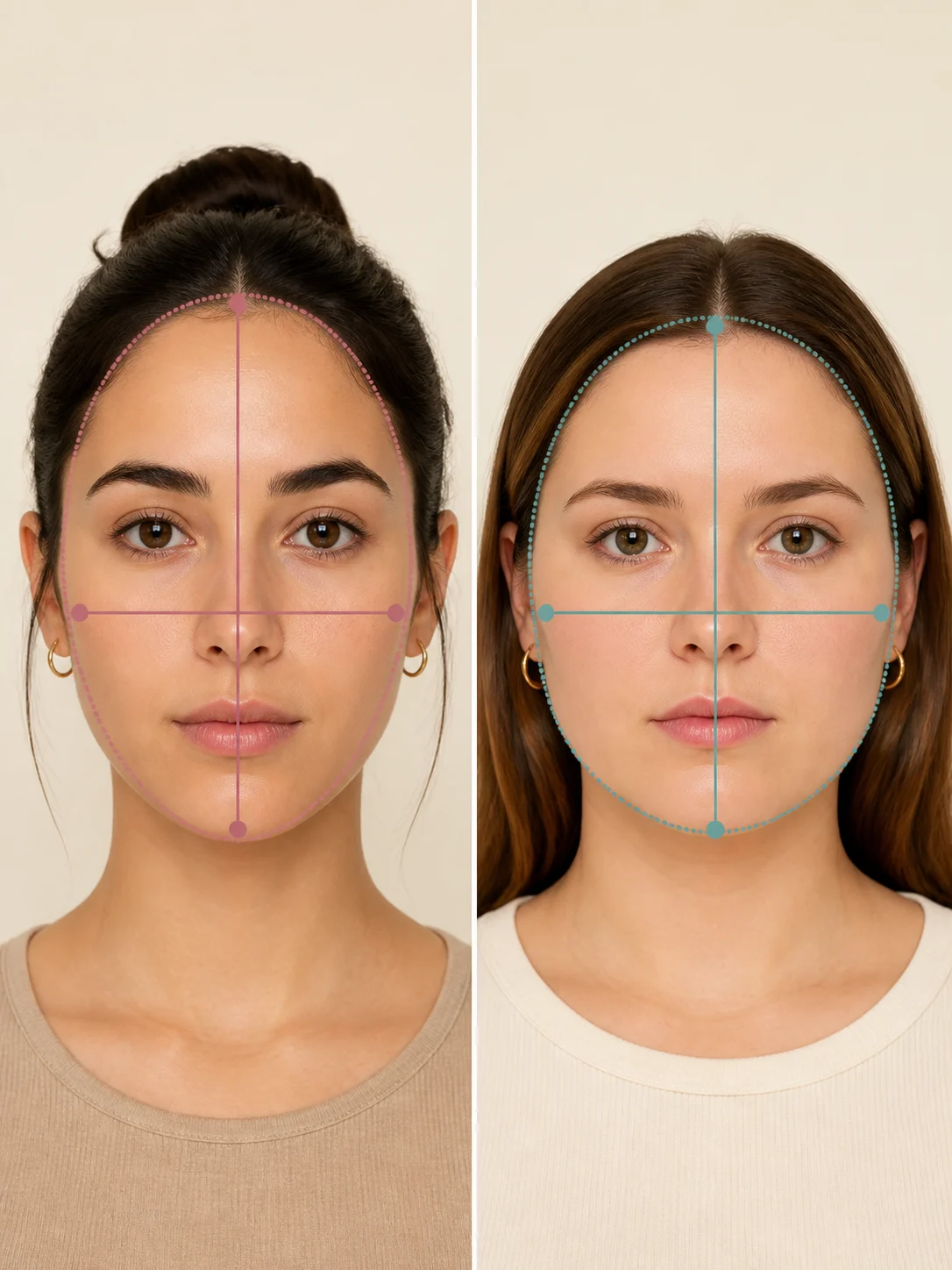
Measure the visible outline from one front-facing photo. The length-to-width relationship should be checked before cheek fullness.
Oval and round comparison table
Dimension | Oval pattern | Round pattern | Best check |
|---|---|---|---|
Face length | Clearly longer than wide | Closer to cheekbone width | Length-to-width ratio |
Forehead | Balanced, often below cheek width | Soft and broad | Visible temple span |
Cheekbones | Often subtly widest | Broad and visually prominent | Width, not cheek volume |
| Jaw | Gently narrower | Curved with little taper | Side contour below cheeks |
| Chin | Rounded, sometimes mildly tapered | Rounded, integrated into jaw curve | Whole lower-face transition |
The chin is rarely decisive because both types can have a rounded tip. Start with the length-to-width relationship, then use taper below the cheekbones as the second test. If both signals remain close, the honest result may be an oval-round mix.
Measure the features consistently
Use a neutral reference image
Place the camera near eye level and step back far enough to reduce wide-angle distortion. Keep the head upright, expression relaxed, and lips together without clenching. Pull hair away from the temples and jaw. The photograph needs the visible hairline and chin because a cropped vertical measurement cannot separate oval from round.
Mark four lines
- Face length: visible hairline center to the bottom of the chin.
- Forehead width: widest visible span across the upper forehead.
- Cheekbone width: widest point from one side of the upper cheeks to the other.
- Jaw width: distance between the two jaw corners, measured with the same method on each side.
Use pixels, millimeters, or any consistent unit. The ratios matter, not the physical size. Divide face length by cheekbone width, then compare the jaw and forehead values with the cheekbone value. If two widths differ by less than about five percent, record them as similar unless a second photo confirms the difference.
A step-by-step decision process
Step 1: test the vertical proportion
If the face is clearly longer than the cheekbone span, oval becomes more likely. If length and width are relatively close, round becomes more likely. Do not use hair height or the full head; start at the visible facial hairline and stop at the chin.
Step 2: locate the widest region
Both types may be widest at the cheeks. In oval, that width often creates a gentle midpoint before the face narrows. In round, the broad cheek area is part of a more continuous side curve and the jaw loses less width below it.
Step 3: trace the jaw rather than judging fullness
Follow the outline from the widest cheek point to the chin. A visible inward taper supports oval. A broad arc that stays relatively full before joining a rounded chin supports round. Ignore temporary cheek volume and focus on the outside contour.
Step 4: rule out neighboring patterns
A broad, angular jaw and widths that stay even may support square, not round. A much longer face with forehead, cheeks, and jaw nearly equal may support oblong, not oval. If the upper face is clearly widest and the chin narrows, compare heart.
Step 5: repeat only when the photo improves
Repeating the same uncertain measurement on the same distorted selfie does not add confidence. Retake the image with better distance, even light, and a neutral expression. Then choose a primary label and record a secondary influence if one dimension remains split.
Worked example 1: a round result
Imagine a front-facing photo with face length 16.0 units, cheekbone width 14.2, forehead width 13.5, and jaw width 13.3. The length-to-cheekbone ratio is about 1.13. The cheekbones are widest, but the jaw loses only about six percent of that width. The sides form a broad curve and the chin continues the curve rather than creating a distinct taper.
Round is the stronger match. The compact vertical ratio carries the most weight, and the broad lower-face arc supports it. The fact that the cheekbones are technically widest does not make the result oval; many round faces also reach their maximum width through the cheeks.
Worked example 2: an oval result
Now use face length 18.1 units, cheekbone width 13.8, forehead width 13.1, and jaw width 12.2. The length-to-cheekbone ratio is about 1.31. The jaw is roughly twelve percent narrower than the cheekbones, and the outline narrows smoothly below the cheek line before reaching a rounded chin.
Oval is the stronger match. The face is not extremely long, but its vertical lead is clear and the lower-face taper is visible. The rounded chin does not make it round because chin shape is only one part of the overall outline.
The figures illustrate a method, not universal thresholds. A few points of perspective distortion can change a ratio, which is why contour and repeatable photo conditions remain necessary.
Photo pitfalls that make oval look round
- A broad smile: pushes the cheeks outward and can shorten the visible distance to the chin.
- A very close camera: enlarges the middle of the face relative to the outline.
- A lowered chin: compresses the vertical dimension and hides the jaw transition.
- Side lighting: creates a shadow boundary that is mistaken for the actual edge.
- Hair covering the jaw: removes the taper that would otherwise support oval.
- A square crop: can make a longer face feel compact even when the measurements have not changed.
Photo pitfalls that make round look oval
- A camera above eye level: visually narrows the lower face and increases the apparent vertical span.
- A raised chin: stretches the visible neck and jaw transition.
- Hair that covers the cheek edges: hides the widest horizontal region.
- Portrait retouching or lens correction: may narrow the face unevenly.
- Strong contour makeup: can create an artificial inward line beneath the cheekbones.
Use the original, uncropped photo when possible. If an edited image is the only reference, treat the result as lower confidence.
Handling mixed oval-round traits
When length moderately favors oval but the jaw remains broad and curved, “oval-round” may describe the photo better than either extreme. When length is close to width but the lower face tapers clearly, check the measurement points and keep oval as a secondary influence.
Decide which feature matters for the practical question. For a haircut, vertical proportion may be the most relevant cue. For glasses width, the widest horizontal region may matter more. Review both the oval face guide and round face guide instead of pretending the boundary is exact.
What the AI Face Detector can and cannot do
The AI Face Detector uses facial landmarks from a suitable photo to return a best-fit shape, secondary match, and proportion cues. It can provide a consistent second reading when manual estimates vary.
It cannot recover edges covered by hair, remove strong camera distortion, or classify a changing facial expression as if it were neutral. Its result is a broad styling reference, not a medical, identity, or attractiveness judgment. Check the reported measurements and photo-quality feedback before relying on the label.
Frequently asked questions
Can a slim person have a round face?
Yes. Round refers to outline and length-to-width proportion, not body size. Body composition can affect visible fullness, but it does not determine the category by itself.
Can an oval face have full cheeks?
Yes. Cheek volume and cheekbone width are different observations. If the face remains clearly longer than wide and tapers below the cheekbones, full cheeks do not automatically change it to round.
Is a pointed chin compatible with a round face?
A strongly tapered chin may point toward a mixed or neighboring pattern, but one feature is not enough to reclassify the face. Recheck the upper widths, jaw curve, and vertical ratio together.
Do I include my ears when measuring face width?
No. Measure the visible facial outline at the cheekbones, not the ears or hairstyle. Keep the endpoints consistent on both sides.
Why does my face look rounder in phone selfies?
Phone selfies are often taken close to a wide-angle lens, which changes relative depth and can emphasize the center and cheeks. Step back, use a longer focal length if available, and keep the camera level.
What if the detector says oval but I measure round?
Check whether the hairline and chin were visible and whether the camera was level. Compare the tool's proportion cues with your lines. If both readings remain plausible, use oval as the primary and round as the secondary match, or retake a better photo before deciding.