How to use celebrity face-shape examples
Celebrity examples can make abstract proportion labels easier to compare, but they are not ground truth. The classifications below are editorial observations based on commonly visible outline cues in front-facing photographs. They are not identity, medical, ancestry, personality, or attractiveness judgments. Different stylists may reasonably place the same person in a neighboring category.
Photography also changes the evidence. Lens distance, head angle, expression, hairstyle, facial hair, makeup, age, and retouching can all alter the visible outline. Use each name as a prompt for noticing proportions, not as a template your face must match.
This page deliberately uses an anonymous editorial method board instead of celebrity photographs. It avoids implying image endorsement or using an unlicensed portrait, while keeping attention on the measurements that transfer to your own photo.
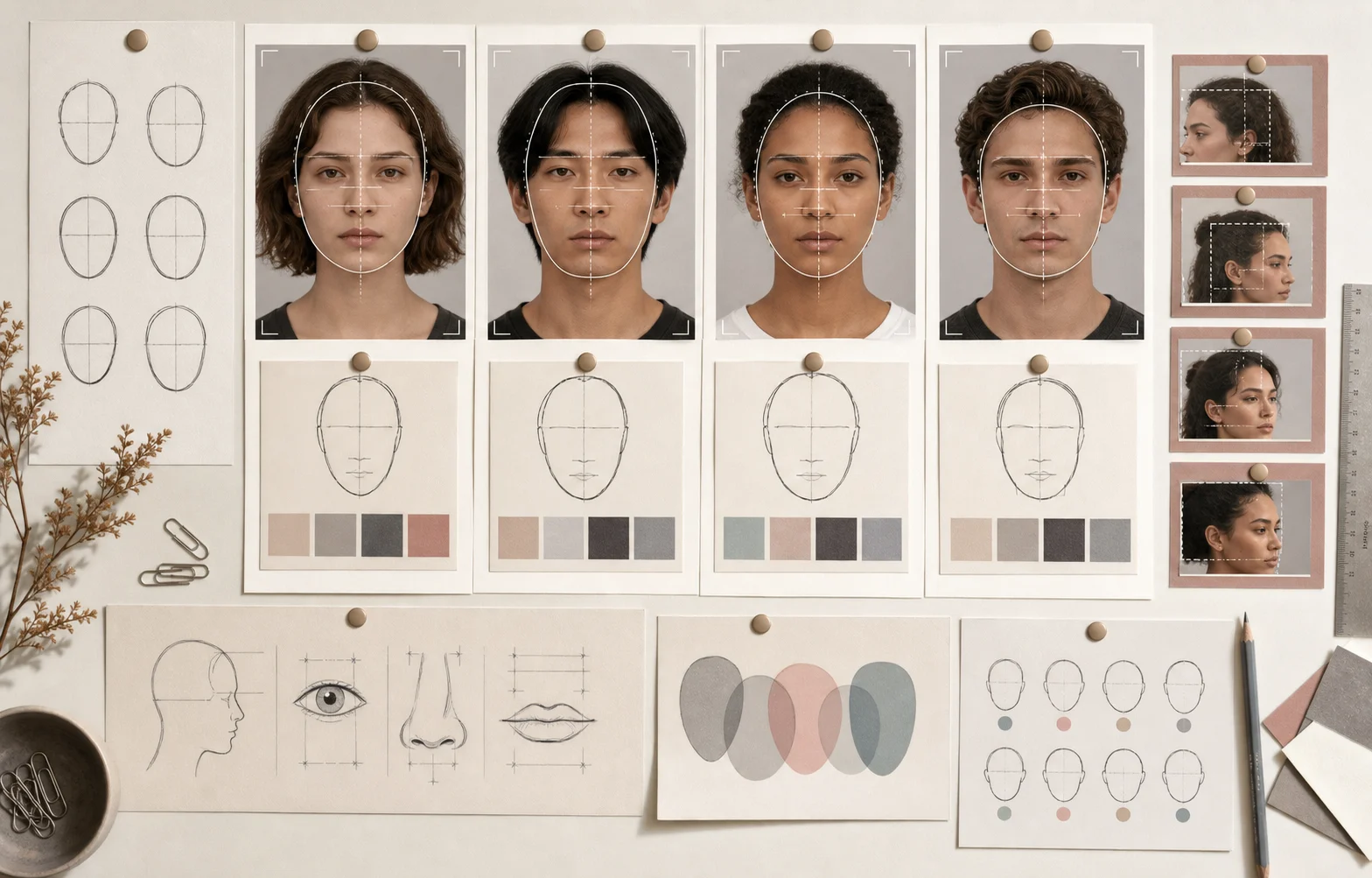
Use celebrity examples as editorial references, then compare face length and the relative widths of the forehead, cheekbones, and jaw on your own photo.
The editorial method
Use at least two clear, near-front-facing photographs taken at different times. Ignore hair volume and trace only the visible facial outline. Then compare five cues:
- Is face length clearly greater than cheekbone width?
- Is the forehead, cheekbone span, or jaw the widest region?
- Do the sides curve, taper, or remain relatively straight?
- Is the jaw rounded, tapered, broad, or angular?
- Does the chin continue the jaw curve or form a distinct point?
When one cue conflicts with the rest, keep a secondary label. For example, a person can be described as primarily oval with heart-shaped upper-face traits. The complete face-shapes guide provides a measurement table for applying the same method to your own image.
Oval face examples
Beyoncé is commonly described as an oval editorial reference because many front-facing images show a face longer than wide, balanced upper widths, and a jaw that narrows without becoming sharply pointed. Styling and camera angle sometimes make the cheek line look broader, so the useful cue is the gradual taper rather than one fixed silhouette.
Jessica Alba is also commonly described as an oval editorial reference. The outline often appears softly elongated, with cheekbones subtly leading and a rounded lower-face transition. Some photographs introduce heart-like traits through the forehead and chin, which shows why a secondary description can be appropriate.
See the oval face guide when moderate length and soft taper are the strongest clues.
Round face examples
Selena Gomez is often described as round because many images show a compact length-to-width relationship, a broad cheek area, and a curved jaw. Other angles can look more oval. The transferable lesson is to measure vertical proportion instead of using cheek fullness as the only signal.
Chrissy Teigen is commonly placed in round or oval-round categories. Front-facing photographs can show strong cheek width and a continuous lower-face curve, while some styling creates more visible length. This is a useful example of a boundary case rather than a perfect diagram.
Use the round face guide, or review oval versus round when length is the deciding question.
Square face examples
Angelina Jolie is commonly described as a square editorial reference because of a strong, angular jaw and relatively balanced horizontal widths. Some photographs read as rectangle-like when vertical length is emphasized. The jaw angle should be considered alongside the length ratio.
Katie Holmes is another commonly described square reference. In suitable front-facing images, the forehead and jaw stay comparatively broad and the lower-face corners remain visible. A camera above eye level can narrow the jaw, so level images are more informative than photographs taken from an elevated position.
The square face guide explains how an angular, even-width outline differs from a curved round one or a jaw-led triangle.
Heart-shaped face examples
Reese Witherspoon is commonly described as a heart-shaped editorial reference because the upper face often appears broader while the lower face narrows toward a distinct chin. A narrow chin alone is not enough; the top-to-bottom taper is the useful pattern.
Kerry Washington is another commonly described heart-shaped reference. In supporting photographs, the upper face carries more width and the outline narrows toward the jaw and chin. The useful observation is the full upper-to-lower taper, not the shape of the chin in isolation.
Read the heart-shaped face guide for the distinction between an upper-face-led outline and a cheekbone-led diamond.
Why oblong needs extra caution
Published celebrity lists often mix oblong, oval, and rectangle without explaining their vocabulary. Rather than presenting a disputed person as a definitive oblong example, use the proportions themselves: clear vertical length, forehead-cheek-jaw widths within a relatively narrow range, and less taper than a typical oval outline.
Use the oblong face guide and the focused oblong versus oval comparison to examine those cues. If a source calls the same outline rectangle, check whether it is emphasizing a more angular jaw rather than a different length ratio.
Diamond face examples
Jennifer Lopez is commonly described as a diamond editorial reference, while some sources use oval. The diamond reading depends on a cheekbone-led outline and narrower upper and lower endpoints, not on makeup placement or highlighted cheeks.
Halle Berry is commonly described as a diamond reference in images where the cheekbones form the widest region and both the upper and lower face narrow. Hair covering the temples can exaggerate that effect, so an unobstructed hairline remains important.
The diamond face guide explains why the widest region matters more than a pointed chin.
Triangle and pear terminology
Triangle is not used consistently across style publications. Some use it for a jaw-led outline that widens from forehead to lower face; others call that same pattern pear. Some sources reverse the triangle and use the word for a wider upper face. Because the vocabulary itself conflicts, a celebrity name without a proportion definition would create more confusion than clarity.
Use the triangle face guide for this site's definition: the jaw is clearly wider than the forehead, and the lower face carries the strongest visual width. State that relationship whenever using the label.
Rectangle as an adjacent editorial label
Some editorial systems separate rectangle from oblong. Joan Smalls and Tracee Ellis Ross are commonly described as rectangle references because suitable photographs may combine clear vertical length with straighter sides and a more angular jaw. These observations remain sensitive to angle and styling.
The current detector does not return rectangle as a separate result. Its seven outputs include oblong and square, so use the rectangle face guide to interpret rectangle-like structure alongside the tool's proportion cues.
Why celebrity classifications disagree
Two careful editors can use different label vocabularies. One may reserve oblong for every long, even-width face; another may split softer examples into oblong and angular examples into rectangle. One may describe a face as oval based on the overall outline, while another emphasizes a broad forehead and chooses heart.
Disagreement is not automatically an error. Check whether each classification is based on a different photograph, a different taxonomy, or a genuinely mixed pattern. A useful explanation names the deciding features. A weak explanation simply repeats a label without showing the width relationships behind it.
Editorial sources and review scope
The named examples above were retained only where established style publications showed a reasonably stable editorial pattern. The classifications and terminology were cross-checked against these references:
- Who What Wear's face-shape guide, which provides named editorial examples across several common categories.
- Beautyblender's face-shape guide, which describes the proportion cues behind common labels and includes editorial examples.
- GQ's face-shape and haircut guide, used to check how another editorial system defines long and angular categories.
- Allure's hair-contouring guide, used to check where beauty publications merge or separate neighboring labels.
These sources do not officially diagnose anyone's face shape, and they do not all use identical taxonomies. They support an editorial comparison, not a verified personal fact. This review was last checked on September 1, 2026. No source photographs are reproduced here.
Frequently asked questions
Are celebrity face shapes officially confirmed?
Usually not. Face-shape labels are editorial interpretations of visible proportions, not official personal facts. Treat the examples as comparison references and allow neighboring classifications.
Can I identify my face shape by finding a celebrity look-alike?
That is unreliable. Two people can resemble each other in expression, features, or styling while having different outline proportions. Measure your own face length and widths instead.
Why does the same celebrity appear under two categories online?
Different photos, age, styling, facial hair, taxonomies, and editorial judgment can all shift the result. Look for an explanation of the measured or visible cues rather than counting which label appears most often.
Do hairstyle and makeup change face shape?
They change the perceived outline and emphasis, not necessarily the underlying proportions. Move hair away from the face and use neutral makeup when the goal is classification.
Does the detector recognize a celebrity?
No. The AI Face Detector estimates a broad face-shape category from landmarks in a suitable photo. It is not designed to identify a person or find a celebrity match.
Can I use a red-carpet photo for measurement?
Only with caution. Such photos often involve angled poses, strong lighting, long lenses, makeup, and retouching. A level, front-facing personal photo is a better measurement source.